


 The diseased trees in front of the building where I work have been cut down so now there is nothing between us and the cars in the Ferry Lane car park but a shallow fenced moat!Makes us feel a bit exposed - was startled by friends waving at me from the car park while unlocking my bike to go home!
  However it does have its compensations - apart from much more light , we can now see to the other side of the river. While consulting scientific journals in the upstairs office, I've watched fascinated as the boats appear and disappear with the tides and the patterns in the mudbanks change.
 I particularly like the rusting metal and shapes in this old hulk, a different view from the one observed from the other bank at the Watermans
 I can see me sneaking out at lunchtimes with a sketchbook and a pair of binoculars (this was the highest magnification I could get with my camera ) , looking shifty on the towpath!
 Would you believe that this is the Thames?! At Brentford, the river has islands ('Aits') in the middle and as the tide changes the main part flows down the Kew bank.
  This is the same spot where Ian and I had lunch at the Watermans a few weeks ago watching the tide change but I never imagine the water level could be quite so low, it looks like someone's pulled the plug out!
 I loved the patterns in the mud and gravel - I'll have to look at the tide charts to see when I might get an opportunity to sketch
  The photographs, drawings , sculptures and textworks were interesting and often beautiful in themselves in addition to representing in varied ways the act of walking. But as I was going round I realised I was thinking as much about my own interaction with landscape and interpretation of it, relating his work to my own experiences.
  In Room 3, mainly wonderfully grainy photos of walks and 'interventions' in the landscape, he talked of ' making a circle of stones, just placing a stone at every mile, or carrying a stone from one place to another' . This made me think of the World Beach Project and the fun Ian and I had last year in Greece, making us look at a familiar landscape in a different way.

 The idea for 'Transference' in room 5 was "first making a walk on Dartmoor recording various things. Then later on a completely different walk in Japan, I deliberately looked out for and could find certain things that were the same as on Dartmoor. It is about a symmetry of places, or events, on different sides of the world, and universal phenomena"
 That it something I could relate to. I've been to many nature reserves in UK and Europe as part of my job but when I visited this 'swamp' reserve on Mt Chokai in Japan, it felt both familiar and alien. I could recognise that some plants were orchids but frustratingly couldn't name them ( the guide book had no latin names - so much for it being the universal taxonomic language) Food and meals feature in his 'transference'. I'd taken my normal walking snack of Duchy Original cheese nibbles with me to Japan , but I never anticipated eating them with chopsticks during a picnic in a carpark!


 I did several journal quilts and paintings exploring this subject earlier in the year and even pieced a quilt top which I put aside to work on my FoQ entry. Time to return to working on this piece I think. Not sure I'll use mud though!
 Pleasanter memories are of taking pictures of the snow settling on the trees at the back of my previous property. It formed the basis of my first experiments using Photoshop to manipulate the images and my very first Journal Quilt in January 2003! I used the ideas to make a larger piece ( detail above) which it is hung in our dining room. I like the restricted , restrained palette.
 I ventured out on a shopping expedition to the High Street , well bundled up in my waterproof and walking boots with trekking pole. The gaiters were a bit of a struggle to get into as I don't use them very often - purchased after a snowy walking holiday in the Troodos Mountains in Cyprus when I got fed up of snow getting into my boots. Worth it tho'!


 Our next door neighbour Myra gave us a Xmas card with a very similar view - where the Grand Union Canal joins the Thames (in the distance on the far bank is Kew Palace).
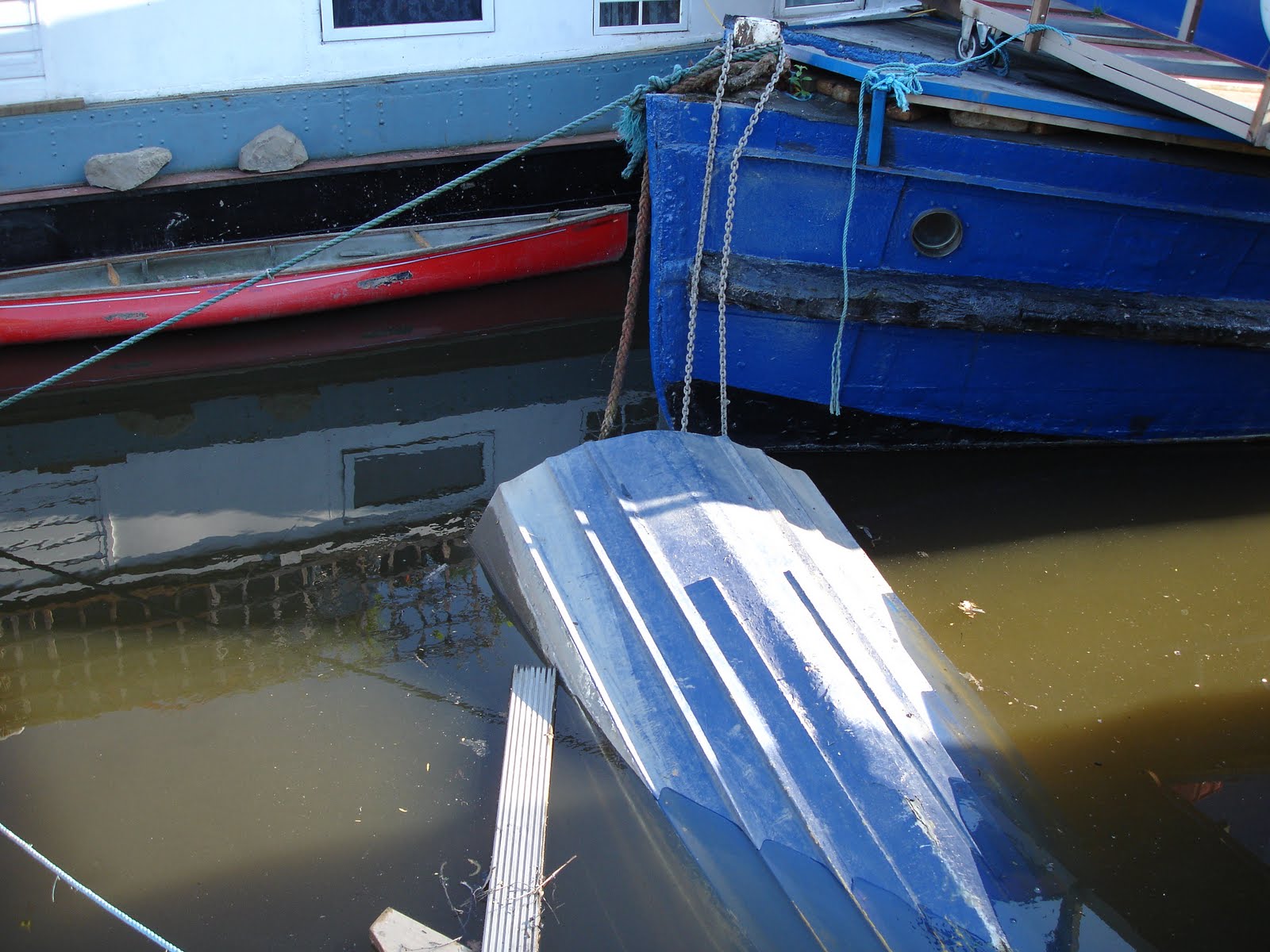
 Boatyard at Brentford
  Cranes
 Thames looking East
 The Grand Union Canal meets the Thames
