Showing posts with label rust marks. Show all posts

Wednesday, 28 June 2017

Printing the Coast and Ravilious and Co

  It's over a week now since I was 'Printing the Coast' with Alice Fox at Studio 11 in Eastbourne.  I had a fabulous inspiring time , with lots of ideas to take forward.
 On my arrival I was lucky enough to catch a talk by curator Andy Friend of the 'Ravilious and Co' exhibition at the Towner Art Gallery . The accompanying book is lovely  with  prints on high quality paper and an interesting, lively read. The exhibition by Becky Beasley based on one of Ravilous's interiors included some large painted vintage fabrics!

 It's a huge exhibition and I only had time to skim the surface, I was particularly struck by how Ravilious captured sound in ' Cross Channel Shelling'  

Our first day in the studio  we constructed some simple folded 8 page pamphlets of  thick cartridge paper  then headed to the beach , spending an hour ( which went very quickly ) making drawings and beachcombing


Rusty bits of metal were a particular focus ,immovable  larger pieces  on the breakwaters used for making rubbings . For collecting  we hit  the jackpot   under the pier where there was some old  scaffolding parts , Alice had already been out foraging for nails at a place  further along the beach where they burn pallets.
In the afternoon we were setting up rust prints on paper and fabric using tea  ( a process I'd already done with Alice a few years ago at CQ winter school ) . I loved the results on paper, some interesting ones on fabric too but I still have mixed feelings on it as is difficult to stitch.

 5 of us staying  in accommodation  met up for  dinner at 'Harry Ramsdens' . I think I'm done for fish and chips for the year now! Afterwards I spent a while walking along the front to the sounds of the 'Jersey Boys' playing at the bandstand to a packed enthusiastic crowd.


The  second day we headed off at 9.30 ( already very hot) to Cuckmere Haven - definitely a candidate for my list of favourite places.  I didn't get very far along the path  when seeking out shade I came across this windblown hawthorn with a secret path underneath. I took rubbings and attempted to capture the negative spaces between the branches


Then , the  bright violet of thyme in the turf on top of the chalk bank caught my eye  and I managed to find a path to the top, rewarded by the best chalk grassland I've seen since my survey days of Salisbury Plain Training Area 30 years ago. I was in botanical heaven , sitting amongst the smell of thyme watching the bees and butterflies. Not much drawing went on, I was reminded of being on Prawle Point  when  all the six-spot burnet moths were emerging, not much painting got done then either!


The views of the river were spectacular too, little changed since Ravilious painted it.


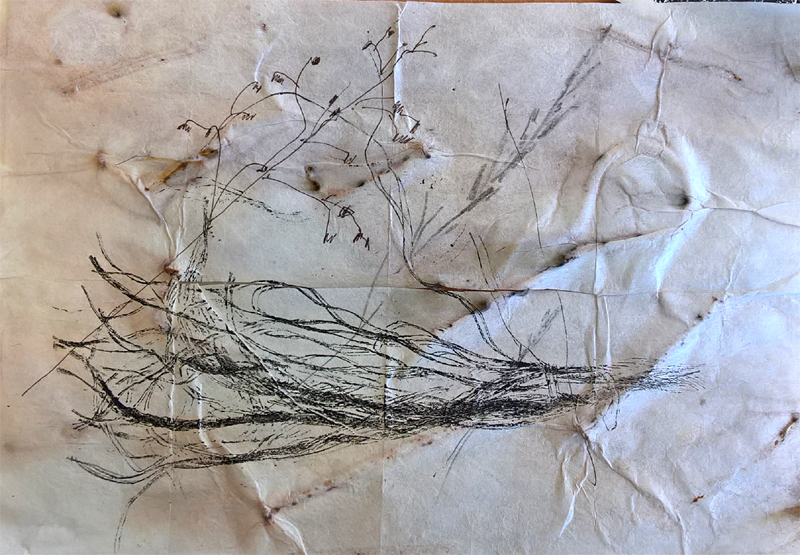
Sitting in an overgrown bank among longer grasses, I found my favourite , 'quaking grass'  and remembering sketching on Box Hill,  drew the shadows cast on the paper

I never did make it to the beach and the view of 'Seven Sisters'.
I lost track of time and was late back to the car so hadn't collected much in the way of plant material for ecoprinting which was the focus of the afternoon . I have mixed feelings about picking plants, even though I took only what I knew to be very common or weeds.  

For ecoprinting, rather than using mordants, we were wrapping fabrics with rusty bits of metal. Mine weren't very successful but it worked better on paper where we inserted flat bit of metal along with the leaves into our books and these were clamped with rusty bull dog clips!

There were a few issues with the steam not penetrating the pages,  the softer , more absorbent khadi papers  worked better. Alice uses an electric steamer - its' on my list , they're not very expensive.

Our tables and boards were beginning to look very interesting and varied now!


Our 3rd day, even hotter, we headed back to Seven Sisters climbing down the staircase at Birling Gap. Besides drawing on pamphlets , taking rubbings etc , our focus was collecting flat objects for monoprinting (eg feathers,  bits of rope)
It was a treat to use the etching press , the embossed details of the feather were lovely
 Most of the time I was just as happy with inking up a manky bit of  rope and using a roller.  Rather than doing one drawing over a whole opened up pamphlet, at Birling I'd drawn on it  folded and consequently had a wider range of marks and layers (above) . The printing made an interesting addition to my drawings of grass shadows (on  which I'd also carried out some rust printing ( below)
I missed the morning session of the 4th day as I was unwell ( reminder to wash hand thoroughly after handling beach finds!)  so only had time  for a quick catch-up on waxing papers with  soy wax and  different book construction methods before we packed up.
The 'Australian reverse piano hinge' was a revelation - no stitching or glueing involved and once back at the hotel (I was staying another night) I put together 2 books  which I'm very pleased with   


We did quite a few drawing on thick tracing  paper which interacted well with other pages in the book. I particularly liked the drawings below  of the cliff face at Birling where you can  catch glimpses of lines beneath the surface ( and note the anchoring 'pins' used in the binding)


The structures are quite springy  so I made some retaining bands of leftover strips of paper (below)

I'll definitely be  continuing with the idea of   taking out pamphlets out with me when I go sketching and exploring more ways of building up layers of marks. Also writing more ( one of the outcomes too from sketchbook course at City Lit). With  repeat course of ecoprinting with Brunhilde coming up at FoQ I'm  starting to think about collecting and pressing plants and using papers as well as fabrics .

.

In regard to fabrics , Alice asked me whether I would use them in my work. Probably not as I like to hand stitch and I don't like handling the  rusted fabrics. Photos of the lovely marks printed onto  fabrics are an option I've used before for journal quilts.
Having said that,  a lot of the marks reminded me of breakwaters  and along with some fabrics from  previous rust dyeing session  maybe  a piece will come out of it.


Tuesday, 18 November 2014

Rusty Journal Quilts -real and faux

Rust Shoreline 
Rust Shoreline detail
Rust Ripples 
Rust Ripples detail 
Greenhouse Door Rust
 Rusted silk habotai  couched on digital print of peeling paint of Alston Hall greenhouse door

African Scrap Door 
( no rusted fabrics: Ndobe indigo, African Kola and Indigo, Potassium permanganate, commercial )

The question of what you do with the bits you produce on workshops: use them in Journal Quilts.
 I enjoyed  trying out   rusting on fabrics and papers  using teas with Alice Fox  and produced some lovely marks on  small pieces ( thanks Olga for  highlighting  my  efforts on the Ragged Cloth Café blog) . I made up a small book and  applied the stitched pieces  to pre-machine quilted backgrounds. I love the resulting textures of these  but I don't think I will be pursuing this technique further as  after the initial excitement , I'm struggling  to work out how I incorporate them in my main series.

It's partly a scale issue: I prefer   yardage  such as my indigo shibori to small  pieces, however exquisite, and I'm a quilter not an embroiderer. It's a process issue:Alice does not wash or iron the  the resulting fabrics liking the folds and creases and applies these to felt or other fabrics. That   fits her aims and ethos but not mine.  It's a fabric issue: the  nicest marks were on thin silk habotai  which I can't easily mix  with the cottons I usually use.  Mainly though it's a colour issue: as a painter the marks, colours and especially tones  achieved are just too subtle and unpredictable .

I overheard  several times people stating authoratively that my 'Fleet Mudflats' quilt contained rust marked fabrics. It doesn't - it's a mixture of commercial printed fabrics and African kola and indigo with some digital prints of sand ripples. My African Scrap Door JQ above also contains no rusted fabrics.  
Fleet Mudflats
 
When you learn a technique or process, however much you admire the work and ethos of the tutor, you have to decide whether it fits with your own work. On this occasion I have  no immediate use for it - I'm  happier with faux rust effects.  But having learnt it , it's in my arsenal  for  the future  if appropriate.  

Sunday, 26 October 2014

Visit to Salt Mills, Saltaire

A year ago I combined taking some  plants to handover to Natural England  staff with visiting 'Cloth and Memory 2' at Salt Mills, Saltaire and although there is no exhibition  there at the moment, it worked well  so repeated it this year. Very mixed emotions as it's probably the end of my involvement  after nearly 25 years.  Arriving around 11.30  for discussions  and disbelief over coffee and cakes then a look around the Hockney exhibitions , time spent browsing in the book and art shops  , resisting the gorgeous jewellery ( I succumbed last year!). Most of all some time for contemplation  and reflection away from work, making plans on the trains   

During  CQ winter school  on rust marks with Alice Fox, we were having a discussion about Cloth and Memory exhibition, how interesting it was. People had different favourites and  many of us ( myself included) found that what stuck in our minds  after a year was not necessarily  what grabbed us at the time.  I was also looking around Saltaire this time with fresh eyes , seeing some of the  areas that inspired Alice, like the broken yellow lines on the cobbles. I got some strange looks taking this photo from the gangs of schoolboys that were hanging around the station!
 
  There was one piece of work by Machiko Agano from that exhibition  that was redisplayed in one of the entrance areas on the ground floor.  It looked very different in a  new context. Many of the Japanese pieces although  based on the themes of Cloth and Memory  do not seem so powerful in retrospect as those that were inspired directly from the building itself and the processes and people  it represents. The following photos are from last year.
Diana Harrison 'Handkerchiefs'  inspired by the flagstones
Jeanette Appleton " Production Line:People's Lives" Felt books/ledgers placed within the walls of the spinning room
Rachel Gray 'Shadow Pieces' stitched layered , patched and mended,  worked well with the peeling paint of the walls.

David Hockney ipad drawings
One of the reasons I arranged the meeting for a Wednesday was that so I could see  David Hockney's ' 25  Trees and other pictures' Besides the 3 huge photographs showing these trees in different seasons, finding beauty in the mundane ( it included a bus shelter!) there  was a projection room showing the latest drawings done on iphone or ipad which he sends regularly to the gallery.  Lots of vases of flowers ( glass works particularly well using this medium)  and other quick sketches, so lively.  'The Bigger Picture' at the RA a couple of years ago  remains for  me one of the most memorable exhibitions of recent years.