Showing posts with label Lake District. Show all posts

Thursday, 20 February 2020

Surface, Structure, Stitch at City Lit: Week 6


  Week 6 already of  Surface, Structure , Stitch  with Louise Baldwin  at  City Lit  and we were looking at  joins, seams, darts , pleats , and  tucks.  I'd done some homework   looking through some of the many books I own , especially the ones above.  We looked at the work of  Karen Nichol,  Caroline Bartlett, Joan Livingstone , Debbie Lyddon,  Tanana  Takite

 Louise had  lots and lots of samples : use of darts to give volume; pleats on different fabrics, manipulated into shapes;  joining  different fabrics( the seam of the 'back' being just as interesting); inserting small pieces  into seams; pintucks in different directions  with waxing ; working on the bias  with zigzag giving ' lettuce' effect ;  working with  various weight/types of fabric, giving different effects; smocking, suturing , faggoting  stitches  to join  edges. 
 One technique   caught the imagination of several of us  -  using  a bobbin of  tightly wound shirring elastic ( or ' knicker elastic'  as someone referred to it !)   on very taut fabric held in a hoop, stitching from the top with ordinary thread, 
  I didn't have  a chance to do a ' before' shot  as the tension  while stitching finally came too much  and it burst out of the hoop !  Nice effect but  would need a lot of practice ( and hand winding the tensioned bobbins was hard )

 Thinking of my limpet shapes, I spent  time just using  different  weights of calico and  muslin , using darts to make the shape and then using pin tucks in between to give structure ( Louise suggested I could insert kebab sticks in the pintucks to give it even more form )  


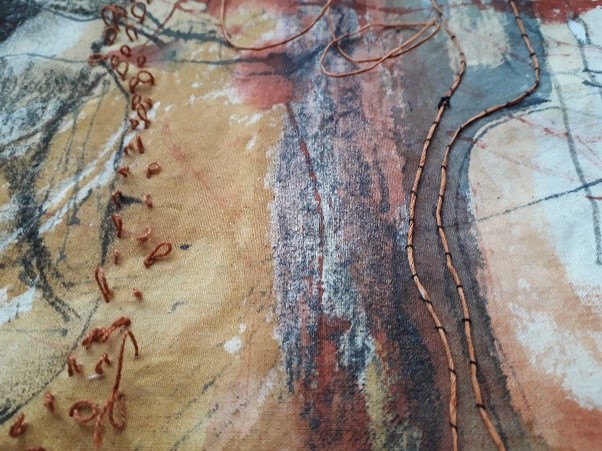
 I'd bought some of my ecoprinted fabrics with me  and started to apply  the same processes to that 
 Then  while I was in pleating   mode,  Louise suggested I use the 'Princess Pleater' smocking machine .  Caroline Bartlett  ( who also teaches at City Lit)  puts yards and yards  of it through  to make her work .  
  This is my  16 needle Read Pleater which I bought secondhand  years ago   for shibori but have used very little,  but I'm keen  to experiment  with after   seeing its potential.
 The hardest part  was threading the needles as I'd cut my left thumb badly and the plaster made it difficult  to hold.  The trick is to use long lengths of threads   to push the pleated fabrics off the needles .  I put through  strips of muslin, folding it as  I turned the handle;  cotton organdie  and the ecoprinted  linen ( which being so soft   was lovely to work with )


 This could get addictive  but I need to concentrate on sorting out what I'm going to take on my annual textile retreat   at Glenthorne in the Lake District  next week ( it'll be my 9th trip) .  As I'll be missing a class , Louise   went through what we'd be doing exploring the possibilities of using one shape in a variety of ways , manipulating and making multiples so I have homework to do !  


Saturday, 16 March 2019

EDAM tutorial - a lot to think about


On Saturday 9 March, I had my EDAM 2nd Term tutorial with Ute Kreyman. Filling in the questionnaire   and talking through how the drawing course was feeding into my art practice gave me a lot to think about.  I took in the cloth I'd been working on when on  sewing retreat in Glenthorne and  photos of both my drawing and textile work  as a basis for discussion 


I'm really enjoying the challenge of EDAM, learning to love charcoal and working on large scale, moving away from   representational to more abstract, reacting to layers and marks rather than preconceived pictorial idea.

Of particular value/interest   in regards to composition  and large scale mark making was large scale drawing  with Tony Hull,  starting off  with blind drawings of object,  building up layers , drawing wrapped object   then disrupting  what had produced, adding extra paper. 
 I started off by showing past work  in quilts – square/rectangular  format as  I will be working on 2 similar  pieces  for group exhibition at Creek Creative, Faversham in September . 


 With   my most recent piece ‘Wind Me In  The Sea’  ( currently exhibited in  7th European Quilt Triennial )  I've  been looking  at  working in  a more 3D  format , double sided, continuous loop. 


          I'm interested in recording journeys/mapping ( carrying out research both online and in books - I received several for Xmas! ) and  was am inspired by the Oceania exhibition at RA, the  teachers notes on Marshall Islands map and John Pule. 


 Besides my drawing practice ( sketching every day  as well as the EDAM work) I talked about the 
importance  of ‘ Mapping a Sense of Place’  with Mathew Harris -  going for a walk , collecting
 objects, recording  memory of    walk   in inks on paper/ primed calico strip . Blind drawing of 
objects collected then 6 tasks in   a chosen ‘space’ (looking at line, repetition, shadow etc ) and 6
 processes ( paint, stitch, collage , etc) order  selected using dice. 


I'd tested out and repeated  the procedure   in my  recent   sewing retreat in Lake  District  with addition of making  quick sketches  along  walk as aide memoire  ( as well as taking photos ) .I also made detailed drawings of some of the objects I collected. 
This process has a lot of potential that I wish to explore further in local area ( eg walk to station)


 In moving towards a more sculptural approach Ute suggested I could: 
-  look at   work of David  Smith -  sculpture with sense of drawing  eg Hudson River Landscape 
( which was one of my favourite pieces in the Abstract Expressionism exhibition at the RA )


-          Try using fabric  manipulation , use like clay or wood , keep small
-          Drawing in 3d  with mark- making  ( strips of fabric/ thread)
-          Collaging  2d to 3d (colour compositions)
-           Reference  the intermediate drawings  of wrapped object from large scale drawing


 I've always been interested in ceramics, old pots and pot shards , “ the hand of the maker “


 (  and attempted  a 3D piece in fabric before (‘Taplow Vase’)  with mixed success!)   


We then  discussed  what I found most  difficult and ideas for the 3rd term individual project and exhibition . I  always have too many ideas,  and difficulty deciding what to concentrate on  ( Advice that can only understand 1 message in 1 piece, the rest  should be noted in sketchbooks )

The exhibition at RK Burt  will be  ‘Works on Paper’  .
As I  wish to  continue with ideas of mapping , I need to investigate how  paper can substitute   for 
fabric in  ‘cloth’   pieces ( concerns  about difficulties in stitching paper as it tears) 
I feel a shopping expedition coming on  to see what papers are available from Shepherds and test out 
properties!

Tuesday, 31 January 2017

Tate Britain: Drawing Tuesday

  Last week's 'Drawing Tuesday' was at Tate Britain  where I followed the exercise we'd done there when I  visited with advanced painting group.  I concentrated mainly on work in the galleries  from  end of 19th beginning of 20th Century . Canadian  artist Elizabeth Forbes  was new to me -  what drew my eye was the interesting composition  and her treatment of  the subject matter ( we've a lot of marshes and channels in the 'land between' around here ) Although quite a gentle palette of colours, I liked the use of light outlining of dark and the brushmarks follow the contours

 Dora Carringtons' 'Farm at Watendlath'  is an old favourite , it really does capture the  Lake District , the lines of the walls and the monumental nature of the fells. It's basically a palette of greens and greys   but with strong contrasts of dark and light. The figures add a sense of mystery.


Whistlers ' Nocturne Blue and Silver  Chelsea'  was an interesting challenge in trying to analyse the colours  in such a subtle piece ( and also  a lesson in accuracy or not in reproduction) The top image is from the Tate website, the photo below what I took with my phone which show how much more varied and subtle the colours and tones were.  It  demonstrates  how important it is to see artworks in the flesh. The  bushstrokes were very evident - it looks like glazes over a darker ground  and the boat looked like paint had been removed . Lovely murkiness ! It reminded me how much I enjoyed the exhibition 'Turner, Whistler,Monet' and had me returning to the catalogue!  
 I only realised a bit later that all 3 examples I chose to examine had high horizon lines - obviously a subliminal preference of mine that I should take heed of .
After lunch in the  Djanogly café ( a bit peeved that  unlike  V&A and British Museum, you don't get a  discount in their restaurants  for being a member ) , I revisited the Paul Nash exhibition and  drew a few pieces of work, it really makes you  see what's going on.

Meanwhile,  I've finally finished painting the dining room , it looks so much lighter and  warmer (it's North facing and the coldest room in the house). I'm  pleased with my work, particularly that I haven't lost the knack with skirting boards. When I worked  in a  Youth Hostel  30+  years ago, we were closed for a month for repairs and repainting - I did miles of skirting in the dormitories, hard on the knees  with no carpet and no heating.