Showing posts with label circles. Show all posts

Wednesday, 25 July 2018

Large Scale Sketchbook Week 8 and Conclusions.


It's nearly 4 weeks since the  final session of Large Scale Sketchbook  but with so much going on there hasn't been time to report  on it and record  my thoughts ( tho'  I made sure I wrote up  my notes  in my notebook straight away)  .  At the end of the session I brought my  the sketchbook home , which entailed a taxi from the station it was so heavy. Tomorrow, a couple of  artist friends are coming round to view it so I thought it was about time I wrote about it here!

After Week  7, I'd run out of ideas  about what I wanted to do with work based on the cast courts , mainly  because the subject matter itself didn't inspire.  The night before the final session  I had a brainwave ( or so I thought....) The lines of stairs and curves of the sculpture in contrast to the surrounding architecture  reminded me of the work  I'd done on shells a ( mussels and limpets) in the advanced painting course in  2016. 
 At the time , I concentrated on developing the mussel paintings  set in context of surroundings ( influenced by the work of Paul Nash)  and hadn't done much with the limpets.  I'd been influenced   by the 'Circle' exhibition at Margate Turner Contemporary  , particularly the pile of black discs by Edmund de Waal,  and had drawn and photographed   a stack of limpets , delicately balanced  and carried out  work in Photoshop  combining it with prints of the Fleet  done during   a printmaking course

I gave Tony a whole lot of photos of my sketches/photos to photocopy to A3 size  and while I was waiting,  starting several pages  in,  I assembled a pile of limpets  and drew it large scale  using charcoal  ( which gave interesting marks on the previous page).  I then carried out a number of different approaches using photocopies; graphite and rubber; sanguine pen; coloured pencils;  and cutting out holes through several layers. 


 I was enjoying   applying what  I'd learnt  to new material but a lot  of what I produced wasn't really working.  Luckily at that point it was my turn to discuss my work with Tony.  He was a bit  surprised I'd discontinued with what I was doing in previous weeks when it had been going so well  while applauding the idea of using my own material to try out  what I'd learnt from earlier lessons ( "the Ideal Student" !) . 

The main reason the shells weren't working  as well was because they were on the whole  central on the page and retaining identifiable structure of existing images  and therefore weren't so exciting.  The danger with using material we care about  is that you have to work harder as not so inclined to experiment  or try things out . 

Looking back  at the earlier weeks when we'd been working with still life  with random objects
 and to some extent the Cast Courts  where it wouldn't have been my first choice of subject , I was more prepared to experiment, fragment images, as I was  looking at the shapes and lines  rather than the subject matter.  Looking with  Tony at previous  pages ,  the most exciting  were when I'd left a lot of space , repeated ideas over several pages ( copies of copies of copies)  and made good use of the edge of pages rather than placing images centrally. 

He made suggestions on extending marks over drawings and copies  ( including  use of the negative shapes left when cutting out)   and putting objects at the edge of the page.  Also to be even more radical  with my cutting, removing items completely.  

 This was more like it ! 


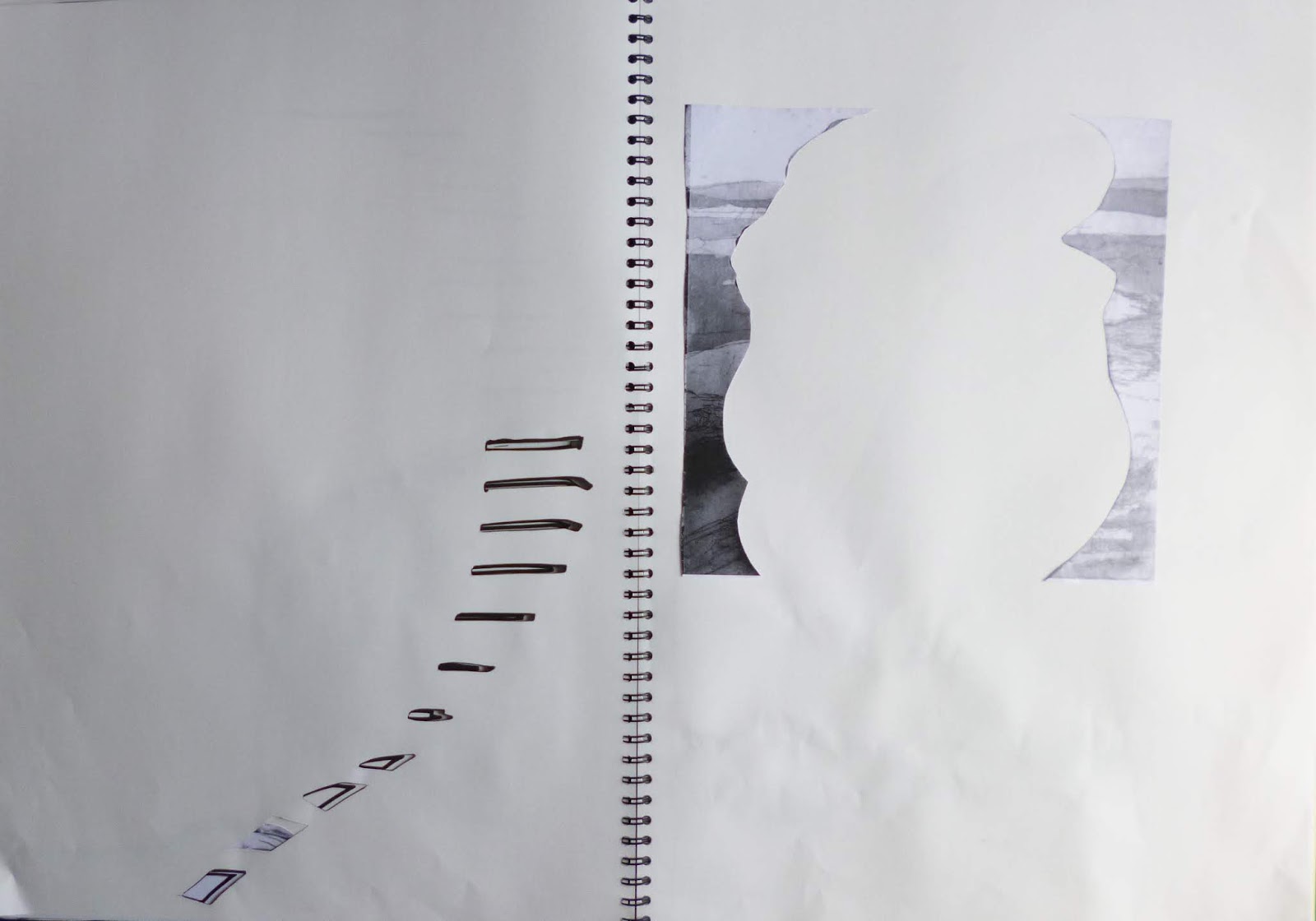
My final intervention  was to go back to the last spread from the cast courts  and cut out the fine lines of the stairs , and extend the line with graphite.  With the negative shapes from around the limpet stack pasted  in , there  was now a link between the  two areas of subject matter.

We  cleared up early  in order to look at everyone' s sketchbook  briefly ( although it still took an extra hour - I missed my train and had to get a later one) . Well worth it though - they were so diverse in approach and content considering we'd all  begun with the same  subject material!
Didn't  make notes at the time but these stuck in my mind:
- finely folded/pleated  paper ( like tiny steps)
- transparent fabric inserts ( also tracing paper and acetate)
- exploded shapes reassembled, photocopies cut into strips and expanded
- images torn up and collaged back ( in some cases just a few tiny pieces)
- layers  of subtle colour  under cutouts
-  images wrapped around edge of page ( so just see a glimpse)
- foldouts
- extreme cutting ( a fine lace-like network).

 I also have a list  of what I like in my own sketchbook  and ideas for future work.
Finally,  as is usual on City Lit courses, there were suggestions about what courses we might want to do next ( printmaking from the images produced  was one).
In my case , I'd  enrolled and paid for Extended Drawing for Artists  and Makers (EDAM)  that morning.   So a year  of experimenting  lies ahead!  

Saturday, 17 February 2018

Contemporary Collage week 4: Conceptual Wall Assemblage 'Head and Heart'


 Being a scientist  and generally making art  inspired  by landscape  or abstracted versions of things I've seen  and recorded, I find it difficult to work with concepts  and emotions  as themes.  But that was what we were  working with  last week. 
 The idea was to put up sheets of paper on the wall, pick a word based on 'states of being'  eg anger   and explore ways of expressing that in visual terms   eg what colour would it be , shape, size,  texture, quick/slow marks etc. We had an overview of   24 of these abstract terms and  examples of  how different artists had used them  eg Rachel Whiteread for 'volume'  casting the spaces under desks in resin ' and Luke Gottelier  for 'scale' making a studio for his hamster.
Working on the wall  ( or in my case a door) gave the opportunity to find links between different elements  and to expand to further sheets of paper.
We formed brain storming groups of 4 to discuss   our words and how they could be interpreted which was useful process, especially as I was way out of my comfort zone. 


As it's 3 years since I left Kew, this has been  on my mind a lot this week.  Initially my word was 'reflective'  but changed to 'regret'.  Working there for nearly 25 years, doing work I enjoyed and made a difference  both for conservation and in training people,  it was a large part of my identity. I used to squeeze art and stitching into any spare time. In the end I didn't need to find a job  but now while in theory I have all the time in the world to focus on art,  one of the main issues I've had to deal with  is deciding my own direction and motivation after being part of a team effort working towards long term goals.  I still miss my colleagues.   On the positive side , Faversham is proving a lovely place to live  and I've  already had  unexpected success in winning Fine Art Quilt Masters although now there are expectations of what I'll produce next! 

 So  lots of complex and conflicting  emotion there , how to express it visually?  I started off with a grid structure   of the growth room shelves and the  circles of Petri dishes , ideas about breaking out of the grid and  positive and negative  feelings.  


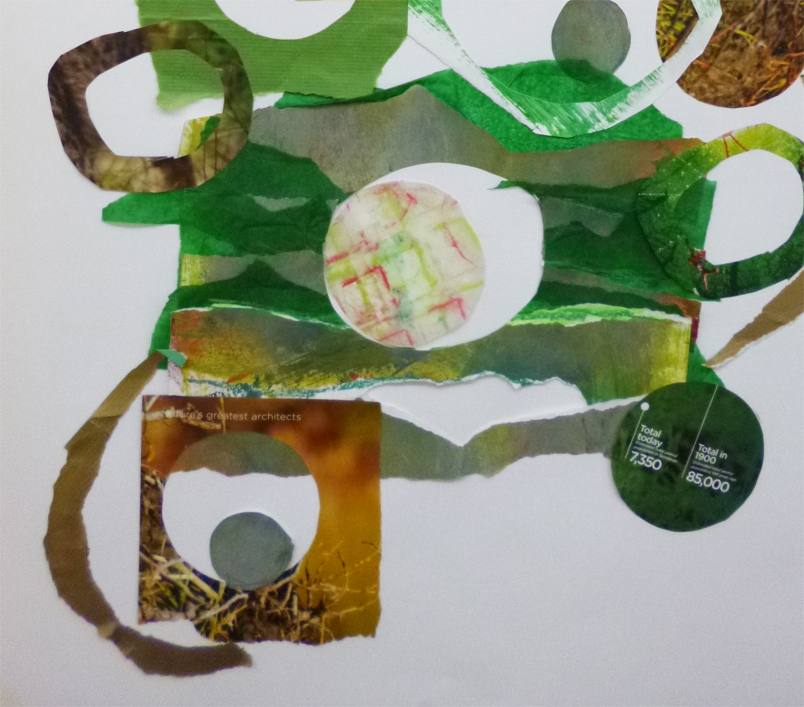
 I continue to have a bit of a thing about circles  and also the outlines remaining when you cut shapes out. This hasn't been part of my textiles so far but perhaps they should be .

At home , I finally got round to sticking in some more leftover bits in my 'scrap book' . 


Monday, 7 November 2016

Paul Nash at Tate Britain

 Another Friday, another exhibition, this time Paul Nash at Tate Britain . It was great to see so much of his work altogether  and see the progression of  ideas  along with repeated imagery. I'm so used to  paying homage to  favourite individual paintings , like the 'Winter Sea' (above)  I visit every time I'm in York and 'The Shore' (below)  in Leeds so it was interesting to see them in context.
The 'Dymchurch' painting drawings and prints  that informed my ' Bexhill Breakwaters' quilt continue to inspire


 It was great to see some of his lesser- known photographs - I've got a  large number of shots of breakwaters and sea defenses too!

 I'm not usually a big fan of  surreal works  but seeing how he used scaled up  objects that had meaning for him set against the landscape  has given me ideas of how I might  combine my ' small treasure' drawings  with seascapes

  I've seen this painting ' A nest of stones' recently at Margate  - it was good to see it  in different company. It features in the frontispiece of my favourite art book  ' The Experience of Landscape' . I've had  it for over 20 years but still find new things  to enjoy  among the combination of  artworks and poetry.   
My journey from the Tate to City lit by bus was fun , on the top deck of a double -decker going via the Houses of Parliament and Trafalgar Square, some interesting details at roof level along the ministries on Whitehall .
In the  Advanced Painting class   we were looking at colour strategies - limited palette ( eg complimentaries, monochromatic, analagous )  and colour inventories.  Enough exercises to keep me happy for months, I love mixing paints.
 This Picasso ' 2 women sitting at  the bar' is  another one of my favourite paintings. , I love the shapes and colours. I once saw it in an exhibition  when I was abroad somewhere, paying a fortune for entry so I could spend 20 minutes absorbing it.

 Many in the class chose to carry out an inventory of a painting, placing squares of colour like  Paul Klee's paintings
 I chose instead to  try and mix the colours found in this photo of 2 boats


  The squares did remind me how useful the 'pixelate, mosaic' filter is in Photoshop as an aid to simplification and identifying the colours

And while I was in Photoshop, I had a go at combining the stack of limpets  collected at Margate  overlaid on the  canvas I painted in Weymouth which I'm thinking of using as the basis for further experiments. Definite possibilities


Thursday, 29 September 2016

Seeing Circles at Margate

After a failed attempt to get to Margate to see the exhibition 'Seeing Round Corners: the Art of the circle ' at Turner Contemporary ( I got soaked through just going to the station and retreated home) ,  when I rearranged  my visit  a week later I had the bonus of Margaret's company. And what a lovely and inspiring day out we had, I'm still  seeing circles everywhere!

 Reviewing the scribbles and notes in my sketchbook, what  has struck me is how many of the pieces I liked  were as much about the process of making as the final result.  I also enjoyed  the links to science and recording observations  such as the X-ray crystallograph  ' Photo 51' by Rosalind Franklin  and the intricate  annotated drawings of light reflections in a concave mirror by Leonardo da Vinci.
 Cloud Arc by Roger Ackling  was made by burning  marks in cardboard using a magnifying glass.No sooner had I thought of the link to Meteorological  suncards when there were examples on display!  

Before  the weather station at Kew Gardens was   updated to digital ecording , one of the daily duties of the weather recorder was to change the suncards (differerent  shaped formats were used at different times of year)  At one time I did this on a regular basis , climbing up a precipitous ladder to the roof of the building rewarded  with excellent views. The 'crystal  ball'  gave beautiful distorted reflections of the surroundings and sky.   The highest temperature recorded in the UK  was  held briefly by  Kew before it was confirmed as being higher at Brogdale. My colleague  who recorded it was on weekend  duty in a tropical glasshouse ! - I was at home finishing off a quilt ( a fan and lots of ice  were essential equipment). But I digress...  

Series of photographs or stills from a film  record the changes  in movement of the sun in sun tunnels in this work by Nancy Holt ( above)   and of the actions of the  tide filling  a flexiglass cylinder ( giving the illusion of a hole in the sea  ) by Barry Flanagan


 Processes of drawing can seem deceptively simple ( Nakahara Nantenbo, above) or  intricately  complex  multilayered 'sea  tracings'  by Trevor Shearer ( below)

 I loved the marks of this site-specific  circle by Richard Long  and how being outside, the shadows constantly change

 This stack of tiny  black porcelain vessels' Littoral' by Edmund de Waal made me think  a stack of  stones or shells  on a beach   so I    collected some limpets and drew them when I got home !  

  Some circles noted on our way back to the  station - my gathering continues