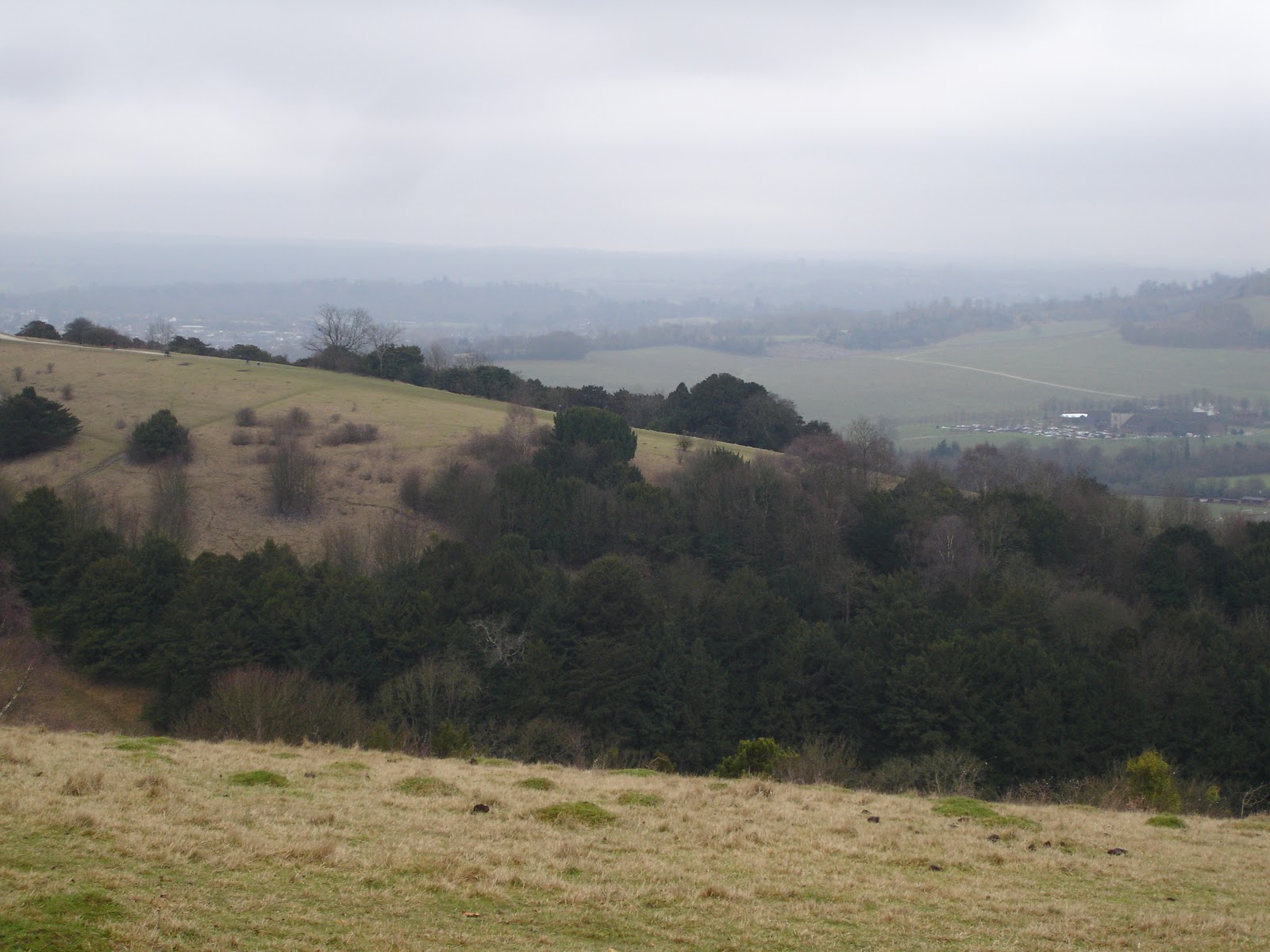
The rain held off and we finally made it to Box Hill to begin building our walking stamina for Crete in April. A combination of the 'Short Walk' and 'Nature Walk' brought us to my favourite bit of chalk grassland with views over the ridge we'd puffed up and distant vistas of Surrey vines.
This spot has provided inspiration for a couple of Journal Quilts - in March 2005, and later in the season October 2008.
Although I'd brought sketching materials, it was too cold to draw so concentrated on taking photos.
A few whimsical like the Tower with a quiff and the moss bird
But mainly rather blurry closeups of textures and shapes (the light levels were low)
I loved the white swirls of old-mans beard against the dark branches.
Then cheeks glowing back to London for a £6.95 veggie curry buffet at Ravi Shanker's on Drummond Street. Now I'm ready for a bath and early night.
Showing posts with label walking. Show all posts
Sunday, 23 January 2011
Friday, 4 September 2009
Richard Long-Heaven and Earth
In between the Chunghie Lee masterclass and my main visit to FoQ, I had a day off to recover(!) which I jam- packed with shopping, coffee with Sue and a visit to Tate Britain ( an easy trip by train from Brentford to Vauxhall). The object of my visit was the Richard Long exhibition.
It stirred me in many ways and will I think leave a lasting impression. It's first effect was to colour my view of the Festival of Quilts - many pieces seemed so fussy in comparison until I acclimatised. Like Olga, I had seen his work in galleries and exhibitions before, and liked it but its hadn't made much impact on me. This time, being surrounded by it, in a large spacious setting with detailed explanations was quite a different experience, sometimes unexpected.
The photographs, drawings , sculptures and textworks were interesting and often beautiful in themselves in addition to representing in varied ways the act of walking. But as I was going round I realised I was thinking as much about my own interaction with landscape and interpretation of it, relating his work to my own experiences.
In Room 3, mainly wonderfully grainy photos of walks and 'interventions' in the landscape, he talked of ' making a circle of stones, just placing a stone at every mile, or carrying a stone from one place to another' . This made me think of the World Beach Project and the fun Ian and I had last year in Greece, making us look at a familiar landscape in a different way. 

Room 4 contained large 'indoor' sculptures of stones-
"I like the fact that every stone is different, one from another, in the same way all fingerprints, or snowflakes (or places) are unique, so no two circles can be alike. In the landscape works, the stones are of the place and remain there. With an indoor sculpture there is a different working rationale. The work is usually first made to fit its first venue in terms of scale, but it is not site-specific; the work is autonomous in that it can be re-made in another space and place. When this happens, there is a specific written procedure to follow. The selection of the stones is usually random; also individual stones will be in different places within the work each time. Nevertheless, it is the 'same' work whenever it is re-made."
The photographs, drawings , sculptures and textworks were interesting and often beautiful in themselves in addition to representing in varied ways the act of walking. But as I was going round I realised I was thinking as much about my own interaction with landscape and interpretation of it, relating his work to my own experiences. 
Room 4 contained large 'indoor' sculptures of stones-
"I like the fact that every stone is different, one from another, in the same way all fingerprints, or snowflakes (or places) are unique, so no two circles can be alike. In the landscape works, the stones are of the place and remain there. With an indoor sculpture there is a different working rationale. The work is usually first made to fit its first venue in terms of scale, but it is not site-specific; the work is autonomous in that it can be re-made in another space and place. When this happens, there is a specific written procedure to follow. The selection of the stones is usually random; also individual stones will be in different places within the work each time. Nevertheless, it is the 'same' work whenever it is re-made."
My favouites here were the Norfolk Flint Circle which made me think of the flint pebbles at Bexhill (above) and 'Slate Line' which put in me mind of the limestone pavement at Malham (below). These had very different properties - white and knobbly versus sleek grey shards but both had interesting things going on in the negative shapes between the pieces.
The idea for 'Transference' in room 5 was "first making a walk on Dartmoor recording various things. Then later on a completely different walk in Japan, I deliberately looked out for and could find certain things that were the same as on Dartmoor. It is about a symmetry of places, or events, on different sides of the world, and universal phenomena"
That it something I could relate to. I've been to many nature reserves in UK and Europe as part of my job but when I visited this 'swamp' reserve on Mt Chokai in Japan, it felt both familiar and alien. I could recognise that some plants were orchids but frustratingly couldn't name them ( the guide book had no latin names - so much for it being the universal taxonomic language) Food and meals feature in his 'transference'. I'd taken my normal walking snack of Duchy Original cheese nibbles with me to Japan , but I never anticipated eating them with chopsticks during a picnic in a carpark!


I did several journal quilts and paintings exploring this subject earlier in the year and even pieced a quilt top which I put aside to work on my FoQ entry. Time to return to working on this piece I think. Not sure I'll use mud though!
The idea for 'Transference' in room 5 was "first making a walk on Dartmoor recording various things. Then later on a completely different walk in Japan, I deliberately looked out for and could find certain things that were the same as on Dartmoor. It is about a symmetry of places, or events, on different sides of the world, and universal phenomena"Since moving to Brentford, I've been much more aware of the tidal nature of the river Thames - from mud to high water in just a few hours. Tides were the focus of room 6 where I spent most time, mesmerised by the huge painting 'White Water Line' . "......White Water Line demonstrates different types of energy. It uses china clay from the big clay pits near St Austell in Cornwall. This work represents the force of my hand speed, and the forces of water, chance and gravity. I make the top line of the image and nature makes the rest, revealing the cosmic variety of the microscale."
I loved seeing the mark of the maker in this and the other'mud' paintings.
The 'dribbles' reminded me of Osterley Weir which was a focus of our canalside walks at Xmas and New Year 

I did several journal quilts and paintings exploring this subject earlier in the year and even pieced a quilt top which I put aside to work on my FoQ entry. Time to return to working on this piece I think. Not sure I'll use mud though!Sunday, 21 September 2008
Box Hill Excursion
As the weather was so glorious we went walking on Box Hill yesterday. We used to go regularly every few months but realise we hadn't been since November 2006, so preoccupied with selling and buying houses and settling in. The main attraction for us is its accessability ( it's even quicker now by train from Brentford , changing at Clapham Junction). I first went there as a student, analysing the vegetation across transects of the path to assess the effect of trampling and then later to wear in new walking boots and practice for trekking holidays. The variety of terrain and habitat and the wealth of flowers and wildlife ( not to mention the National Trust tea stall at the top!) make it a great destination.
My favourite location is this meadow, one of the best in the UK for butterflies, overlooking the main chalk ridge that people walk up. Most visitors congregate around the car park, the tea gardens and the viewpoint with its vista over the surrounding countryside so although this meadow is reached by only 20 minutes walk through the woods, very few of them make it there.
I had a very pleasant 40 minutes sketching here while Ian read and dozed. Not among the best watercolours I've ever done (particularly as I've just changed some of the colours in my paintbox) but there's something magical about sitting among the grasses, hearing the insects and feeling the sun beat down. Definately the pleasure of the process rather than the product.
I tried to capture the colours of the meadow - lime green at the base with a haze of golden brown at the top, silhouetted against the dark green box trees in the distance and dotted through with violet of scabious and gentians. I found a neat way of drawing grasses - tracing the shadows cast on my sketchbook! (the photo below is a mixture of shadows and pencil lines)
The railway station (Boxhill and Westhumble) is a treat in itself with the layers of peeling paint - such a variety of colours.
There's a real sense of connection to the past, people have been visiting for centuries (Box Hill even played a critical role in Jane Austen's 'Emma'). The visitors having picnics yesterday probably aren't that different although most arrive by car rather than train now. It's not the countryside of spectacle and solitude but there's a nice atmosphere of shared enjoyment in admiring the view while tucking into home-made cakes. I collected some blackberries too.
I had a very pleasant 40 minutes sketching here while Ian read and dozed. Not among the best watercolours I've ever done (particularly as I've just changed some of the colours in my paintbox) but there's something magical about sitting among the grasses, hearing the insects and feeling the sun beat down. Definately the pleasure of the process rather than the product.
I tried to capture the colours of the meadow - lime green at the base with a haze of golden brown at the top, silhouetted against the dark green box trees in the distance and dotted through with violet of scabious and gentians. I found a neat way of drawing grasses - tracing the shadows cast on my sketchbook! (the photo below is a mixture of shadows and pencil lines)
The railway station (Boxhill and Westhumble) is a treat in itself with the layers of peeling paint - such a variety of colours.
Subscribe to:
Posts (Atom)


