Showing posts with label mapping a sense of place. Show all posts

Wednesday, 26 May 2021

Sonic Landscapes

 As part of  Alice Fox's 'Place- Making Winter'  course, for the last  6 months I've been recording/mapping  my  daily(ish) walks down  'Abbeyfields'  in Faversham  in different ways. 

So I was delighted to participate in  another project with Kimbal Bumstead as part of his residency at the  BasementArtsProject   this time making  audio recordings on my phone   in my 'Place'  and  then drawing from  the recording with my eyes closed, responding to the sounds and textures.  From the submissions made by the participants  he has created a   digital collage ' map'  and a 'sonic journey' to accompany it.    The result is interactive - you can move through  the 'landscape'   accompanied  by the soundtrack, highly recommended ! 

SONIC LANDSCAPES — Kimbal Quist Bumstead (kimbalbumstead.com)

Abbeyfields  1 

There was  a zoom meeting  with some of the participants talking about what they got out of it.  On many of my walks  I was aware of the  some of the  sounds (  a patch of brambles  with lots of sparrows I call the ' shouting bush ' ! )  but listening  to the recordings at  home  with headphones on  and replaying it again and again I was able to isolate and identify  far more. The crescendo  of a car or bike going past on the road; the rhythms of a dog barking ; distant clanking of boat masts, blurred conversations  and used different media and colours to try and  capture those qualities on paper. 
 A fascinating process which  I hope to repeat  which has added a new dimension and awareness to my walks .   Maybe have a go at blind stitching to the sounds  ( as on Dorothy Caldwell course) 

Abbeyfields 2

Abbeyfields 3 

Abbeyfields 4 


Kimbal's  'Sonic Landscape': screenshots of Digital Collage ( above)   and detail ( below)  


Sunday, 5 May 2019

EDAM Term 3 : First thoughts on 'Meanwhile...'

 The morning of the  first session of EDAM   this term was  devoted to  discussing progress  on   our 'homework' over the Easter  break of researching ideas through drawing  on the subject of "Meanwhile..."  to be interpreted  any way  we decide. This is working towards a show of work on paper at the RK Burt Gallery in July.
We were given some references/ starting points : "The Last London"  by psychogeographer Iain Sinclair; "Milkman" -novel  by Anna Burns   and link to  Layers of London  mapping

Given my current interests  in mapping, and sense of place , the latter is what interested me most.  Several   people had read the articles and novel ( I  read summaries/ extracts  and decided  they weren't for me )  and the diversity  of approaches  was fascinating. Some people had done a lot of preparation and drawings  already , others ( like me)  had  some ( too many?) ideas  but hadn't yet  decided  what to pursue . 
The tutors emphasised   at this point  the use of drawing to investigate and explore possibilities, the process being more important than the result, to open up  rather than  refine or close down choice .

I had the disadvantage of presenting  my ideas first  when  people were more reserved and polite .By the time we'd gone round the room ( with a coffee break in between) , there was lots of interjects of artists that might be of interest, resources  to look up, linkages and common areas of interest. What a great group.  

  My initial  thoughts on 'meanwhile'   was travelling on the Javelin line trains between Faversham and St Pancras International. A  'space out of time'  with no distractions ( apart from looking out the window!) , it's where  lately I've been  most productive creatively , able to think, plan, stitch.   " Wind Me The Sea" was mainly   stitched on the train ( in an airline seat  with a small basic sewing kit) and the artists  statement references  the continual loop of the train line ( from St Pancras , after Faversham it continues round the coast and then back to St Pancras  via Ashford International). 
The train is what made it possible to move from London to Faversham, be mortgage free  and yet still  be able to commute to work.  We still remember  our train journey on the day we moved house , technically homeless, communications with the solicitor on the phone being interrupted  when in 'Tunnel Land' with no signal.      

I'm interested in the schematic representation/diagram    of  the train route in comparison to  on a map ( and have bought different scale maps  from OS  to trace  from ) In February , one of my daily drawings ( top)   was of some of the things I notice  from the train: rolling fields and orchards :oast  houses; Rochester cathedral, castle and bridge; Gravesend Sikh temple ; the emptiness of the Hoo Peninsula; Rainham Marshes ( my favourite section ) 


 With my interest also in  archeology and old bits of pot  I did some research  on the excavations made when digging  the HS1  route , what lies beneath  (like the elegant map above  of finds  when excavating Crossrail ) . Which is how I discovered about the 'Ebbsfleet Elephant' - fascinating! 
I've also been looking at  repeating the  mapping processes on cloth  applied to the walk from my house to the station (  based on maps of directions I drew  for friends)  


It's a long  time since I used my camera and even longer since I used  it to take blurred photos   from the train  ( even in 2008  I was talking about revisiting  previous work! ) . That included the Journal Quilt I made  after 7/7  and the piece I eventually  made based on Shinkansen journey in Japan. 
This was influenced by the series  'Separate Landscape' by Atsuhide Ito    about 'non-places' and it's  been interesting to catch  up with what he's working on now 


Taking these photos  from my seat between  Ebbsfleet International and Stratford International ( the high speed section)  I was  very aware  of the sudden switch from views out of the window speeding by , to tunnel walls  and fencing as descended and then the reflections of the interior of the train in the windows . I get so absorbed in writing/ stitching, doing the Metro crossword , in my own little world, it is only in the tunnels , when cut off from signals to the outer world that I become aware of other people , even if it is just their reflections. 

 Now I need to think further on the aspects of this  theme that I wish to explore further and what drawing techniques I might use 


Saturday, 16 March 2019

EDAM tutorial - a lot to think about


On Saturday 9 March, I had my EDAM 2nd Term tutorial with Ute Kreyman. Filling in the questionnaire   and talking through how the drawing course was feeding into my art practice gave me a lot to think about.  I took in the cloth I'd been working on when on  sewing retreat in Glenthorne and  photos of both my drawing and textile work  as a basis for discussion 


I'm really enjoying the challenge of EDAM, learning to love charcoal and working on large scale, moving away from   representational to more abstract, reacting to layers and marks rather than preconceived pictorial idea.

Of particular value/interest   in regards to composition  and large scale mark making was large scale drawing  with Tony Hull,  starting off  with blind drawings of object,  building up layers , drawing wrapped object   then disrupting  what had produced, adding extra paper. 
 I started off by showing past work  in quilts – square/rectangular  format as  I will be working on 2 similar  pieces  for group exhibition at Creek Creative, Faversham in September . 


 With   my most recent piece ‘Wind Me In  The Sea’  ( currently exhibited in  7th European Quilt Triennial )  I've  been looking  at  working in  a more 3D  format , double sided, continuous loop. 


          I'm interested in recording journeys/mapping ( carrying out research both online and in books - I received several for Xmas! ) and  was am inspired by the Oceania exhibition at RA, the  teachers notes on Marshall Islands map and John Pule


 Besides my drawing practice ( sketching every day  as well as the EDAM work) I talked about the 
importance  of ‘ Mapping a Sense of Place’  with Mathew Harris -  going for a walk , collecting
 objects, recording  memory of    walk   in inks on paper/ primed calico strip . Blind drawing of 
objects collected then 6 tasks in   a chosen ‘space’ (looking at line, repetition, shadow etc ) and 6
 processes ( paint, stitch, collage , etc) order  selected using dice. 


I'd tested out and repeated  the procedure   in my  recent   sewing retreat in Lake  District  with addition of making  quick sketches  along  walk as aide memoire  ( as well as taking photos ) .I also made detailed drawings of some of the objects I collected. 
This process has a lot of potential that I wish to explore further in local area ( eg walk to station)


 In moving towards a more sculptural approach Ute suggested I could: 
-  look at   work of David  Smith -  sculpture with sense of drawing  eg Hudson River Landscape 
( which was one of my favourite pieces in the Abstract Expressionism exhibition at the RA )


-          Try using fabric  manipulation , use like clay or wood , keep small
-          Drawing in 3d  with mark- making  ( strips of fabric/ thread)
-          Collaging  2d to 3d (colour compositions)
-           Reference  the intermediate drawings  of wrapped object from large scale drawing


 I've always been interested in ceramics, old pots and pot shards , “ the hand of the maker “


 (  and attempted  a 3D piece in fabric before (‘Taplow Vase’)  with mixed success!)   


We then  discussed  what I found most  difficult and ideas for the 3rd term individual project and exhibition . I  always have too many ideas,  and difficulty deciding what to concentrate on  ( Advice that can only understand 1 message in 1 piece, the rest  should be noted in sketchbooks )

The exhibition at RK Burt  will be  ‘Works on Paper’  .
As I  wish to  continue with ideas of mapping , I need to investigate how  paper can substitute   for 
fabric in  ‘cloth’   pieces ( concerns  about difficulties in stitching paper as it tears) 
I feel a shopping expedition coming on  to see what papers are available from Shepherds and test out 
properties!

Monday, 12 November 2018

Mapping a Sense of Place: the role of chance


On the  course with Matthew Harris 'You are Here' in Puglia ,  how we responded  to our 'space' on our fabric pieces to a series of prompts  was chosen by throwing a dice. The  order of the tasks we completed in painting, stitching and manipulation our work were selected in the same way.

An interesting , liberating ( and sometimes frustrating) approach,   it both  took  the pain out of deciding what to do  while also taking you outside your comfort zone.   It meant that everyone was doing the same activities  but in completely different  orders ( good for  seeing how others had responded and steal their ideas! ) .  Would  my cloth would have turned out differently if  it had been done in a  different order? Very probably.

The 'Space' Prompts ( and the order I did them )
1( 5th)  Shadow
2 (6th) Line
3 (1st) Repetition
4  (4th) Touch/Feel
5 (3rd) Shape (+ve/-ve)
6 ( 2nd) Construct ( build)

Repetition 

  Repetition 

Repetition 

 My first  prompt was ' Repetition'   so taking my  cloth  to my space I took rubbings   in graphite of the markings on a  metal drain cover; drew oak leaves with the prickly pear orange ink;  used drops of Paynes grey ink to represent the  black moss  ( and folded the cloth to get a print while it was still wet) 
 My second prompt  was ' Construct'  - I found a piece of wood with holes in and  referencing the  mosses and lichens ,  placed acorn cups in the hollow and stuck the( rather fragile ) stalks  of the acorn cups in the holes. Although the idea was to do it in situ, I took it back with me afterwards  to the studio and added some more  but forgot to take a photo.  It did look like  spore capsules of a moss or  ' pixie cup' of a lichen. 
Shape ( positive/negative) 

 The 3rd  Prompt  I tackled was shape ( positive / negative)  , drawing the gaps between the stones on the wall  with crayon.
Touch/Feel 


I didn't spend  long in my space for 'Touch/ Feel'  where I took a rubbing of the oak bark  as appropriately enough , I  managed  to brush past a large clump of 'Spanish Needles' ( Bidens pilosa) and had 100's of the hooked seeds attached to my trousers and socks! I went back to my room to change - it took half an hour  to remove them.  Next time I went to my space I made very sure I went nowhere near them! 
Shadow

 I used  cuts in the cloth for 'Shadow' , the 5th prompt, around the outline of the drawing of the oak leaves I'd done for 'repetition' . As well as recording the  lines cast by actual leaves, the cuts themselves cast interesting marks below . 

While I was there , I took photos  and did a drawing for the last prompt 'Lines'  as I wanted to do this on the cloth in stitch  in the comfort of the studio (  particularly as my subject - the holes in a rock that made up lines  was also where I sat  to draw while in my space!) 


Lines on cloth : paint and stitch 


 The 'Tasks'  ( and the order I did them)
1 (6th) Lay down blocks of colour ( large/small; transparent/opaque) Obliterate/ knock back different area ( a mixture of white emulsion with a hint of yellow to march the calico was used for  this )
2 ( 1st) Select a small detail and work with it on a larger scale ( and vice versa)
3 (2nd) Manipulation (stitch/cut, distort, pleat, cut into surface
4 (4th)  In one area  work  back to front, +ve to -ve,  Try wax resist and layering  colour on top , use stitch as a resist
5 (3rd) Collage with found material, cloth/paper/bundles of threads/paper in response to information already there ( attach with stitch/binding, not glue)
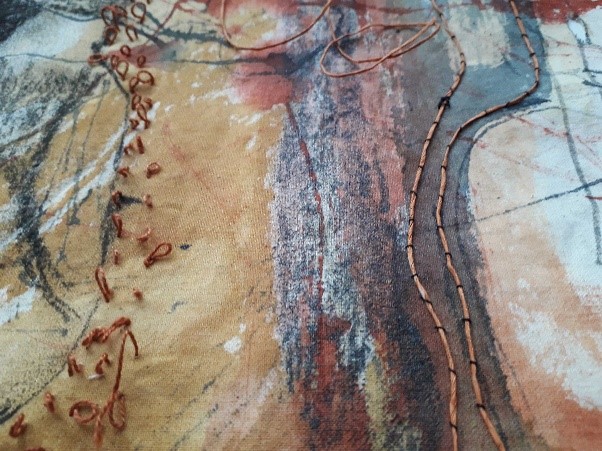
6 (5th) draw or mark  with pure stitch , different scales .


After the first couple of   trips to my 'space' sometimes  I combined  the activity/prompt     with the task (  saved throwing the dice, reusing the same number). As time  went on and the layers accumulated, it becomes a bit tricky to remember what I did  and when!  But then  the process  became more about responding to the cloth  itself and making changes - I'll show the evolution of some areas in another post  but meanwhile , the photos below  show some of the ways I interpreted the 'tasks'. 

T1  Add Colour

 
T1 Obliterate 

 T2  Change scale, T3 Manipulate 

T4   Wax Resist 

T5 Collage 


T6 Stitch