Saturday, 6 December 2014

Scrap Experiments - 2014 Journal Quilts


 The bonus quilts

It's always intriguing looking  at a years Journal Quilts combined  and to see how interesting they look in different combinations.  This year the JQ challenge for Contemporary Quilt  was 8 x 8 inches( 20x 20cm) with a line across the quilt from one edge to another. I initially thought it was too small a format to be worthwhile - in past years I enjoyed the 12 x 12 inch format most. But having decided to mainly use scraps and leftovers I've had a ball,  given myself permission to just play, producing 'bonus' ones  and also using some mounted on 8 inch canvases for sale. I still have lots of ideas and may well continue using this size in addition to whatever next years challenge is.  It's made no impression on my scrap stash!
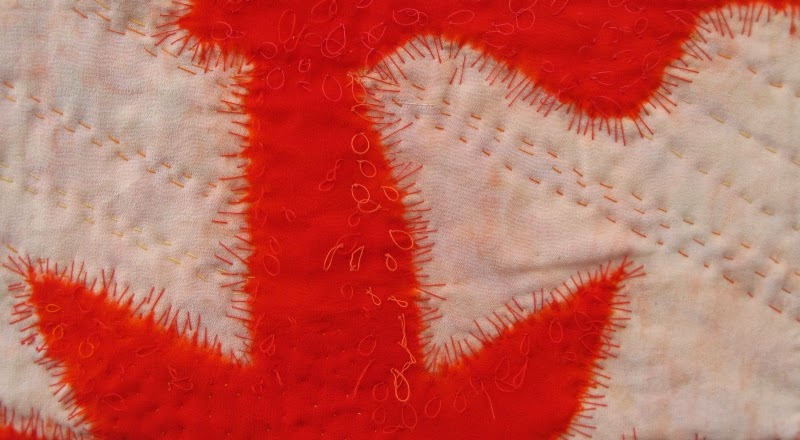
Several of them have been composed and stitched on train journeys - the perfect travel project  and the majority reflect my interests and concerns at  the time, in many cases using bits leftover from larger quilts and projects or  memories of particular times and places. Some people plan the whole 12 months in one go so that it's a cohesive  piece. Not my way - I'm fascinated to see links between pieces (all those wavy shibori -like lines!)  and also the shift in colour palette from vibrant reds to subtle neutrals, no coincidence that  while starting my year  with optimism it is ending on a sombre  note.

Artworks as triggers of memory

 
A day off work  to finally get to see the Anselm Kiefer exhibition at the Royal Academy ( fitting in a few more exhibitions at National Gallery and National Portrait Gallery for good measure). Amazing, monumental and thought provoking. After starting with a display of books, the 'Attic' paintings are powerful  and I love how the wood grain effects are continued throughout his work - the woodblock prints used in the  'forest' of the last room (below) were fantastic. 
The materials he uses are diverse : straw, mud, sunflowers and seeds   and they have meaning for him. The way he uses lead is fascinating - I particularly liked the books 'under the linden '  and large pieces studded with diamonds were just magical in how they caught the light.
The pieces that I spent most time with were in room 5: ' sands from the urns' (below) based on the clay brick ziggurats of Mesopotamia. Hand -pressed mud was used for  clay tablets and bricks and he is quoted as perceiving " a secret connection between writing and building"  wondering whether bricks , like tablet, could hold memories of people , of events, of time.
I was reminded of our visit to Syria  almost exactly ten years ago,   visiting Ugarit , Dura Europas and Mari , in awe of being somewhere where the ancient past is tangible  and hugely saddened by  what's happening there now .  
 
 Ugarit
 Euphrates

Mari
 
Ziggurats of Pastries in Hama
 
After  treating myself to a delicious lunch at Savoir Faire, I headed off to  the National Gallery  to see the 2  very different seascape inspired displays.   I've long admired the dramatic  paintings of  Maggi Hambling  but I was rather disappointed with these 'Walls of Water' .  Lots of lively marks and use of paint but   for me  all pattern and lacking in content and composition.  Her  monotypes on this theme  like they might be more interesting


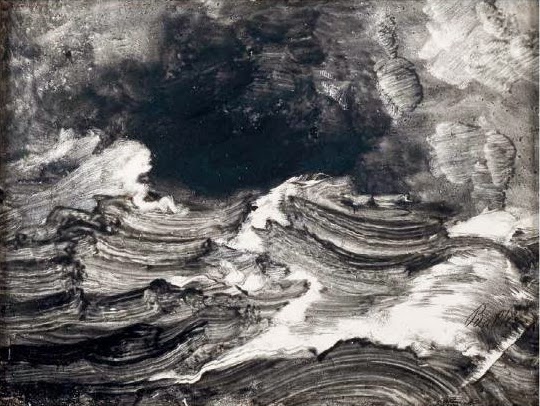
Whereas the paintings by Peder Balke  were far more inspiring especially the smaller sketches. I liked how often the waves were suggested quite simply  - it looked like he might have used a painting knife in a similar way as  demonstrated by Susan Gray on my Slapton painting courses.  

On my way home I popped into the National Portrait Gallery  next door to see the Grayson Perry exhibit ' Who are you' .
You could hardly get near his  'self portrait'  City of Days  for people staring intently and giggling. Complex, funny and profound,  like the Reith lectures and  'Tomb of the The Unknown Artist'.
The 'comfort blanket' a tapestry  in the shape of a bank note   was witty but the most powerful pieces were the ceramics  displayed among the Gallery's collections

I spent a lot of time in front of the  beautiful  yet disturbing 'Memory jar', representing memories torn into shards through Alzheimers.


Sunday, 23 November 2014

Mended Door- Change of Scale


Quilt number 3 for International Threads challenge is   finally completed after several months marinating on the design wall. The theme was change of scale or large/small scale.  I returned to ideas I worked on a while ago on incorporating a photo of door within a large scale detail  as in these JQ's
The smaller scale area  is a photo of part of a patched, mended door with newer wood inserts among the old on Queen Charlottes Cottage in the grounds of Kew Gardens. The larger scale  shapes and colours are based on some of the sections of the photo, a mixture of African batik, hand dyed fabric and monoprints with acrylic paint from Jae Maries course.  I  used different weight threads ( 40 and 12) in these areas to further emphasise the change of scale.

I took this  quilt along to the Thames Valley Contemporary Textiles group meeting yesterday in Bracknell - which apart from our AGM featured an interesting  talk   by Jane O'Brien  on the history of Damask ( co-incidentally I've reading through the silk route section of the 'History of the World in 100 objects). She highlighted the damask on various Renaissance paintings, many in the National Gallery which reminded me of my drawing courses there - remembering how I struggled with the patterns on cloth  in the  Bellini painting of the Doge!  
In the afternoon, it was good to be reminded of design principles, particularly the golden section  and I couldn't resist assembling a small flock from the delightful knitted sheep the Kate Crossley had brought for sale.
 
Ian meanwhile  had been picking the last of the figs from our tree  but even he admitted this time they were seriously underwhelming in taste - we need that Mediterranean sun! 

Tuesday, 18 November 2014

Leaving Kew

On Friday I received official confirmation that my application for Voluntary Redundancy from  the Royal Botanic Gardens, Kew  had been approved.  So with 3 months notice, I will be leaving on Friday 13 February 2015 after nearly 25 years  working there.
There have been difficult times and changes  but none so much as now. I've worked on some incredible projects , particularly on orchids , bryophytes and ferns  and with some  amazing people. I'm proud of my science publications, my books  and my involvement in teaching and training.
I'm not sure what lies ahead apart from downsizing  and moving to Faversham  although I'm looking at reviving my rather rusty botanical survey skills through MMU/FSC courses and fitting in some more time for stitching and painting. Then I need to find another job.


Rusty Journal Quilts -real and faux

Rust Shoreline 
Rust Shoreline detail
Rust Ripples 
Rust Ripples detail 
Greenhouse Door Rust
 Rusted silk habotai  couched on digital print of peeling paint of Alston Hall greenhouse door

African Scrap Door 
( no rusted fabrics: Ndobe indigo, African Kola and Indigo, Potassium permanganate, commercial )

The question of what you do with the bits you produce on workshops: use them in Journal Quilts.
 I enjoyed  trying out   rusting on fabrics and papers  using teas with Alice Fox  and produced some lovely marks on  small pieces ( thanks Olga for  highlighting  my  efforts on the Ragged Cloth Café blog) . I made up a small book and  applied the stitched pieces  to pre-machine quilted backgrounds. I love the resulting textures of these  but I don't think I will be pursuing this technique further as  after the initial excitement , I'm struggling  to work out how I incorporate them in my main series.

It's partly a scale issue: I prefer   yardage  such as my indigo shibori to small  pieces, however exquisite, and I'm a quilter not an embroiderer. It's a process issue:Alice does not wash or iron the  the resulting fabrics liking the folds and creases and applies these to felt or other fabrics. That   fits her aims and ethos but not mine.  It's a fabric issue: the  nicest marks were on thin silk habotai  which I can't easily mix  with the cottons I usually use.  Mainly though it's a colour issue: as a painter the marks, colours and especially tones  achieved are just too subtle and unpredictable .

I overheard  several times people stating authoratively that my 'Fleet Mudflats' quilt contained rust marked fabrics. It doesn't - it's a mixture of commercial printed fabrics and African kola and indigo with some digital prints of sand ripples. My African Scrap Door JQ above also contains no rusted fabrics.  
Fleet Mudflats
 
When you learn a technique or process, however much you admire the work and ethos of the tutor, you have to decide whether it fits with your own work. On this occasion I have  no immediate use for it - I'm  happier with faux rust effects.  But having learnt it , it's in my arsenal  for  the future  if appropriate.  

Tuesday, 4 November 2014

A creative weekend and strange plant memories


At last, some creative time squeezed in this weekend!  Sue  and I had scheduled a 'play date' for Sunday afternoon to look at the results of  our rust dyeing  workshop with Alice Fox and to  do some sewing. So  Saturday was spent assembling bits to work on including some Journal Quilts ( more on that in another post)   and finally getting round to trimming down and facing the first challenge  for 'International Threads' group. I'm embarrassed to say that we're now   on our  fifth ( although I've completed others in between)
It has been almost finished for a long time.  A wholecloth piece of Japanese silk shibori  layered over an African damask ,  it's been a labour of love, hand stitched  using a variety  of loops and other stitches  trying out techniques from Helen Parrott's book. It's accompanied  me on several train journeys, the format of 40 x 80 cm being a good travel piece to work on.
It looks quite sinister and plant-like  reminding me of the carrion flower so I'm calling it 'Red Stapelia' .

At one time in the  small glasshouse at work  where we  had plants that had originally been grown in the lab, there was an enormous Stapelia that took up most of a bench, very  ' Little Shop Of Horrors' .  The smell was something else.... It even had a proper engraved  label which besides  the accession number and  family, genus, species details also bore the  plants name :' Cedric the Poo Plant'. Alas Cedric is no more, removed when the  glasshouse changed use many years ago

Sunday, 26 October 2014

Let's Move to Faversham

 It seems appropriate that leafing through the Saturday Guardian Magazine this weekend at Whitstable station waiting for the train to Faversham to do some house reconnaissance, that this should be the subject of the 'Let's Move To... ' article. We took it as a good omen!
After our trip to Whitstable a  few weeks ago  we  booked a  B&B  to test out the  'Javelin line' on a Friday evening, and  explore the housing there locally while  doing some of the  artists trail. In the meantime we'd done some more research   and Faversham looked like it had potential but  we decided to go to Whitstable anyway to use  it as a base.
Accordingly  I met  up with Ian at  St Pancras at 5pm ( after a brief explore of the continually changing colours  of the  'magic tunnel'  which leads to his offices!). The journey to Whitstable was about 1hr 15mins, very smooth,  and we  were made very welcome at the 'Pearl Fishers'. We were in the 'Paris' suite,  smart art deco with a very high bed - comfortable once  you'd   scaled it. We had a lovely meal at 'Alimo', a  Moroccan fusion restaurant, highly recommended and then a walk along Oxford Street to  see the sea with the nightlife just starting - lots of  good-natured students.
After a delicious breakfast,  we headed to the railway station, picking up a 'Guardian' on the way.

 
In Faversham , just 8 minutes away,  we looked first at the housing south of the railway- lots of  new builds  well within our price  about 15 mins walk from the station. Then we headed into town using a walkway above the railway bringing us out by the recreation ground.  I know that Faversham is known for its medieval streets and its market  but I was unprepared for how pretty and buzzy it was . The market was in full swing with lots of  varied  stalls. We'd popped into the 'Fleuer de Lis' heritage centre for some leaflets and the volunteers were so friendly especially when we said we were thinking of moving there.
After an excellent lunch ( with local Shepherd Neame    beers ) at the  Anchor we headed off on the artist trail.    

Lots of inspiration around the Creeks 
 Brickwork patterns
Lost of black and white ( and other coloured!) buildings
We loved the work of Magz Roberts and Mike Roberts. Magz started off in textiles and Mike has a lovely quirky style in his cartoons.  After a detour via the Abbey Physic community Garden, I heard beautiful singing coming from the church  - Faversham Choral Society having a final rehearsal before their performance that evening.
We finished up at ' Creek -Creative' for coffee and cake and a look round the studios. When I asked what the rent was  ( thinking  that a new house might not have suitable painting facilities)  we were given a  behind the scenes tour! 
An inspirational, welcoming place  and  we're both agreed that Faversham feels right for us.  We'll be back in December for the Xmas markets and to explore a  different  housing area.