Thursday, 20 July 2017

Japanese Woodblock Printing Week: Designing, drawing and cutting

 Day one (Monday)  of Japanese Woodblock ( Mokuhanga) print course at Morley College  with Carol Wilhide-Justin  started with an introduction to it's history and a fascinating account of her  scholarship residency  at MI-Lab in Japan.


 She had  bought an original book from 1830's and it was wonderful to gently handle it,  admiring the  qualities of  the papers and the printing .


Working on a 30 x 22.5cm piece of  Shina Plywood  with an image size of 15 x 10.5 cm ( which allowed 2 separations on each side) , she shared some ideas from her own work  showing how to break down an image into  separate layers ( by colour or to make a pattern simpler to cut) . I liked the idea of combining different shapes and colours ( above and the results below)
But I'd already put quite a lot of work into  developing ideas continuing with my breakwaters theme so despite working on a much smaller scale than  I'd imagined , I decided to combine different elements from  these 2 photos
Having made an accurately sized drawing , this was traced and different colours used for what would be different blocks/ colour separations.

Then  reversing it, these 4 different element were  traced onto the  plywood using carbon paper, paying attention to the direction of the grain. 

The plywood had already been accurately marked out with the area for the image, surrounded on 2 sides with a 1cm gutter and 1cm registration for the paper ( the paper will overhang the edge when printing, a cunning way of getting the most out of the block)  

Then cutting! We used a non-slip mat rather than a bench-hook, much more maneuverable , especially as we had to continually move the block around to ensure cutting away from you. I was first to have a go with the Ken-toh chisel to make registration marks on the corner and along the longest side, watched by the class demonstrating  how not to do it!  My 4th one wasn't too bad.

A set of tools were issued once we'd demonstrated that we could use them. And then the lesson was over and our homework  is to do all the cutting on our blocks for printing on Friday ( this is usually a 8 week rather than 2 day course! )  

On Tuesday , appropriately enough, I went back to the Hokusai exhibition at the British Museum  so I didn't get a chance to do any cutting until Wednesday and Thursday. My orders of 'Powergrip' tools and   Japanese Woodblock  book had arrived in the post , it was good to have  photos and instructions on the very particular ways the different tools are used , a reminder of what Carol had demonstrated.

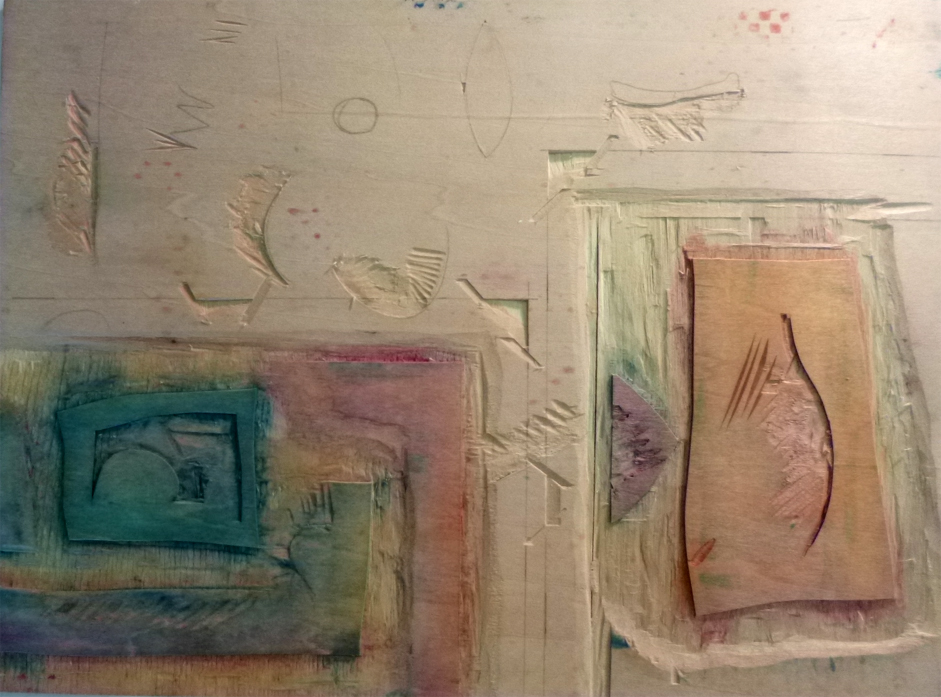
 So here are my finished blocks ready for printing tomorrow .  I love the nuanced effects of the watercolour used  and that it can be done at home  without a press, something I've struggled with when lino printing.

I think my dad would have been proud of me -  he was very keen on working with wood  coming from a long line of wood carvers from coopers in the 1700's to my grandfather who was a  pattern maker on the Glasgow shipyards before becoming a gardener.
30 years of wielding a scalpel probably helped too!  

UPDATE - see  what my  friend Margaret did on the same course - a different approach to design  but very effective.


Thursday, 13 July 2017

Wind Me in the Sea : July Update

  As we're (more than) half-way through the year, I thought it was time I gave an update on my daily/train stitching project 'Wind me in the Sea'

 I started in January , stitching scraps of indigo to both sides of a strip of Japanese kasuri kimono fabric. Those of you who follow me on  Facebook have endured many snaps of  it's progress  on Javelin line trains  travelling between Faversham and St Pancras ( sometimes a bit further afield)  The   comfort thimble is on a piece of elastic as I lost it on the floor so many times  as are the spools of  thread ( which are now much reduced in size). A couple of weeks ago I had  to start using 2 tables (below) as I joined 2 strips together ( I've now started a 3rd new strip which is more portable)  

  In January it looked like this ( above)  and has now grown to  over 2.5 metres ( below)
 I'm starting to play around with how I might display it, I still like the idea of a continuous Mobius strip (it's double sided) but it's not quite long enough for that yet

Suspending it from fishing line might be interesting so it wafts around ( it looks best with light through it) or perhaps putting stiffened wire down the edges so it can be manipulated?

 Or rolled up and placed on a surface in waves?


 Meanwhile the basket of scraps is overflowing and I still get excited trying different combinations of fabric ,threads,  stitch and spacings ( I'm trying to leave more of the background fabric showing through). This week it's been tennis stitching

Faversham Open House : Old Grammar School and Old Pharmacy Courtyard


 Over the last couple of Saturday afternoons I've been stewarding  for the first time  in the Faversham
Society's  Open House scheme, (this is the 48th year!) .  On the 1st July I was at the 'Old Grammar School' which dates from 1587 ( and was in use as a school  until 1879).    


 It's now  a  Masonic lodge but the evidence of it  having been a schoolroom is in the centuries old graffiti carved into the wood panelling which has been preserved!


Seated at the entrance , I was initially puzzled by the number of people walking by with coconuts ( one man gave me a bag of 4 to mind while he went round the building!) .  Turns out they were won at the annual fete  of nearby Queen Elizabeth Grammer School ( the modern day equivalent )  In quiet times between visitors I made drawings in a folded pamphlet  of  the view from my chair.

 I did the same when stewarding on the  8th at the 'Old Pharmacy Courtyard' in the Market place behind the 'Yarn Dispensary' (a pharmacy from the 17th century until the 1980's)

 I'd often walked past this inconspicuous doorway between  2 shops, with it's red plaque with the white horse of Kent little realising what lay behind it.
Down a passageway lined with old timbers and doors that go nowhere  is a remarkably complete mid-15th century timber framed town house!  Almost every visitor  ( over 200!) gasped  at what they saw, it really is a hidden gem .


Not a straight line anywhere!  Stewards perks was a tour of the house itself afterwards  ( 2 flats  with original features lovingly restored  by the current owners).  
 I was particularly taken by the  metre high 'Alice in Wonderland' door which led to a bedroom, even I had to bend over to get through it!
This Saturday I'm at a house in West Street, as seen on our first visit to Faversham.

Drawing Tuesday: Camley Street Natural Park and Kings Place


I see the outside of Camley Street Natural Park  every time I come into St Pancras  train station  ( my main entry point  into London from Faversham)  so  as this weeks 'Drawing Tuesday' venue was at Kings Place, it seemed the perfect opportunity to explore. It really is an oasis of green between the railway tracks and Regents Canal.   I did a quick sketch of the juxtaposition of cranes and gasometers with the  lush green vegetation ( watched by a very tame robin) before the rain started   but I was enchanted by these figures produced by a  visiting school group.


 A lot of the area around Kings Cross is  still a construction site, with conversions of gasometers and development of the 'Coal Drops Yard'
Granary Square with it's fountains  is  very popular with children  and the  Regent's Canal has a lot of quirky boats, a shame this 'bookbarge' wasn't open.


 The Pangolin Gallery at Kings Place was closed  too but still lots of sculptures around to enjoy.  With half an hour before lunch ,  I  had a go at 'Perpetual Red' by Merete Rasmussen  in coloured biros, yet another Mobius  strip, it's becoming a bit of a theme at the moment!


  And afterwards , a quick look round the exhibition of self portraits, I particularly liked these based on a palette  and paintbox.